

Choosing the right lock is not just about keeping a door closed. It is about matching the lock to the level of risk, traffic, convenience, and control needed for the property. In simple terms, residential locks are usually designed for daily household convenience, while com-mercial locks are built for heavier use, stricter security, and better access management.
For a Home
For a home, the main concern is usually protecting family, personal belongings, and privacy. A front door deadbolt, smart lock, keypad lock, or knob lock may be enough, depending on the neighborhood, door type, and lifestyle. For example, a family that often forgets keys may benefit from a smart deadbolt with a mobile app, while a homeowner with a rental unit may prefer a keypad lock that allows easy code changes between tenants.
For a Business
For a business, the needs are different. Offices, warehouses, clinics, retail shops, and restau-rants often have multiple employees, visitors, deliveries, and restricted rooms. In practice, commercial locks must handle frequent opening and closing throughout the day while still protecting sensitive areas like stockrooms, cash offices, server rooms, or employee-only spaces.
Are residential locks and commercial locks the same?
No. Residential and commercial locks are designed for different purposes.
Residential locks are usually built for normal household use. They focus on convenience, privacy, and basic security. Commercial locks are made for heavier traffic, stricter security, and better access management.
A home door may be opened a few times a day. A business entrance may be opened hundreds of times daily. That difference matters because commercial locks must be more durable and reliable.
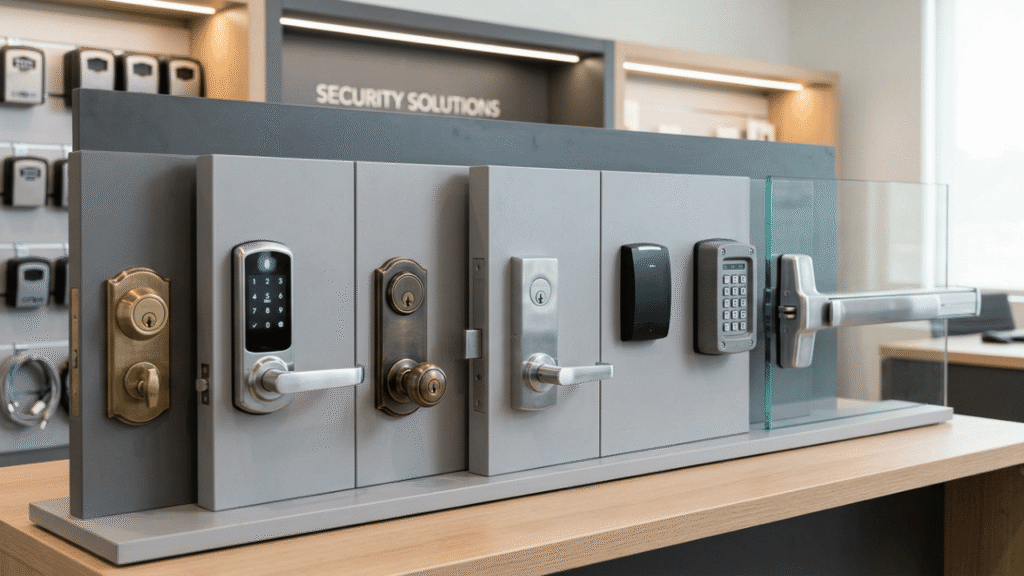
Deadbolts
Are common for homes and small offices because they provide strong basic protection.
Smart locks
Work well for houses, short-term rentals, and small businesses needing remote access.
Keypad locks
Are useful when you want to avoid handing out physical keys.
Mortise locks
Are required in many business exits for safe emergency evacuation.
Panic bars
Are useful when you want to avoid handing out physical keys.
Electronic access systems
Are ideal for companies that need user tracking and permission control.
Are residential locks and commercial locks the same?
No. Residential and commercial locks are designed for different purposes.
Residential locks are usually built for normal household use. They focus on convenience, privacy, and basic security. Commercial locks are made for heavier traffic, stricter security, and better access management.
A home door may be opened a few times a day. A business entrance may be opened hundreds of times daily. That difference matters because commercial locks must be more durable and reliable.
What type of lock should you use for a home?
For your home, your main priority is protecting your family, personal belongings, and privacy. Common residential lock options include:
Deadbolts
Are common for homes and small offices because they provide strong basic protection.
Smart locks
Work well for houses, short-term rentals, and small businesses needing remote access.
Keypad locks
Are useful when you want to avoid handing out physical keys.
Mortise locks
Are required in many business exits for safe emergency evacuation.
Panic bars
Are useful when you want to avoid handing out physical keys.
Electronic access systems
Are ideal for companies that need user tracking and permission control.
A front door deadbolt is one of the most common and effective choices for basic home security. If you often forget your keys, a smart lock with mobile app access may be a better option. If you own a rental unit or short-term rental, a keypad lock can make it easy to change access codes between tenants or guests.
What type of lock should you use for a business?
For your business, you need to think beyond simple entry. Offices, warehouses, clinics, retail stores, restaurants, and other commercial spaces often have employees, customers, deliveries, vendors, and restricted areas.
You may need to protect:
- Stockrooms
- Cash offices
- Server rooms
- Employee-only spaces
- Storage areas
- Medical or confidential records
- Back entrances
- Delivery doors
Commercial locks must handle frequent opening and closing while still giving you control over who enters each area.
What is the biggest difference between home and business lock needs?
The biggest difference is usage. Your home lock may only be used several times per day. A commercial lock may be used all day by employees, customers, and delivery personnel. Because of this, durability is much more important in business settings.
Many commercial doors use grade-rated hardware, such as ANSI/BHMA Grade 1 or Grade 2 locks. These locks are tested for strength, durability, and long-term performance.
Why is access control more important for businesses?
Access control is important because you need to know who can enter, when they can enter, and which areas they can access. At home, you may only need keys for family members or a temporary code for a cleaner, guest, or contractor. In a business, you may have multiple employees with different levels of access.
For example, not every employee needs access to the cash office, server room, storage area, or management office. Access control systems help you manage those permissions more effectively.
When should you use a deadbolt?
You should use a deadbolt when you want strong basic protection for an entry door.
Deadbolts are common for:
- Homes
- Apartments
- Small offices
- Back doors
- Garage entry doors
A quality deadbolt gives you a solid level of security, especially when installed correctly with a reinforced strike plate and strong door frame.
When is a smart lock a good option?
A smart lock is a good option when you want convenience, remote access, and keyless entry.
Smart locks work well for:
- Houses
- Short-term rentals
- Vacation properties
- Small businesses
- Home office
With a smart lock, you may be able to lock and unlock the door from your phone, create temporary codes, check activity history, and avoid carrying physical keys.
When should you choose a keypad lock?
You should choose a keypad lock when you want to avoid handing out physical keys.
Keypad locks are useful for:
- Families
- Rental properties
- Small offices
- Staff entrances
- Service providers
- Shared spaces
Instead of copying keys, you can create and change codes when needed. This is especially helpful when someone moves out, an employee leaves, or a temporary worker no longer needs access.
What are mortise locks used for?
Mortise locks are heavy-duty locks often used in commercial buildings. They are built into a pocket, or mortise, inside the door, making them strong and reliable.
You often see mortise locks in:
- Offices
- Schools
- Apartment buildings
- Retail stores
- Commercial entry doors
They are a strong choice when you need durability, security, and professional-grade performance.
What are panic bars, and when do you need them?
Panic bars, also called exit devices, allow people to exit quickly during an emergency. You push the bar, and the door opens from the inside.
Panic bars are commonly used in:
- Commercial buildings
- Restaurants
- Retail stores
- Schools
- Warehouses
- Public facilities
If your business has public access or certain occupancy requirements, panic bars may be required by safety codes. They are not just a convenience feature; they can be a life-safety requirement.
When should you use an electronic access system?
You should use an electronic access system when you need tracking, permissions, and better control.
Electronic access systems are ideal for businesses that need to:
- Track who enters and exits
- Limit access by employee role
- Set schedules for entry
- Remove access without rekeying
- Protect restricted areas
- Manage multiple doors
These systems may use key cards, key fobs, PIN codes, mobile credentials, or access control software.
What are common lock mistakes you should avoid?
One common mistake is installing a standard residential lock on a busy commercial door. It may work for a short time, but it can wear out quickly and may not meet building or fire safety codes.
Another mistake is giving out too many physical keys without a key control system. If an employee leaves and does not return a key, your business may need to rekey the locks to stay secure.
You should also avoid choosing locks based only on price. The cheapest option may not be durable enough, and the most expensive option may not be necessary. The right lock is the one that fits your door, your risk level, and how the space is actually used.
FAQ about Distinct Lock Choices for Commercial and Residential Use
What is the main difference between residential and commercial locks?
The main difference is the level of use and control required. Residential options are usually made for comfort, privacy, and everyday family access. Commercial options are built for heavier traffic, stronger durability, employee access management, and safety requirements.
Can I use a residential smart lock for a small business?
Sometimes, yes, especially for a private office or low-traffic door. However, for main en-trances, emergency exits, or doors used by many employees, it is better to choose commer-cial-grade hardware or an access control system designed for business use.
Send job details.
Prefer not to call? Send the essentials and the Key Experts team can follow up.